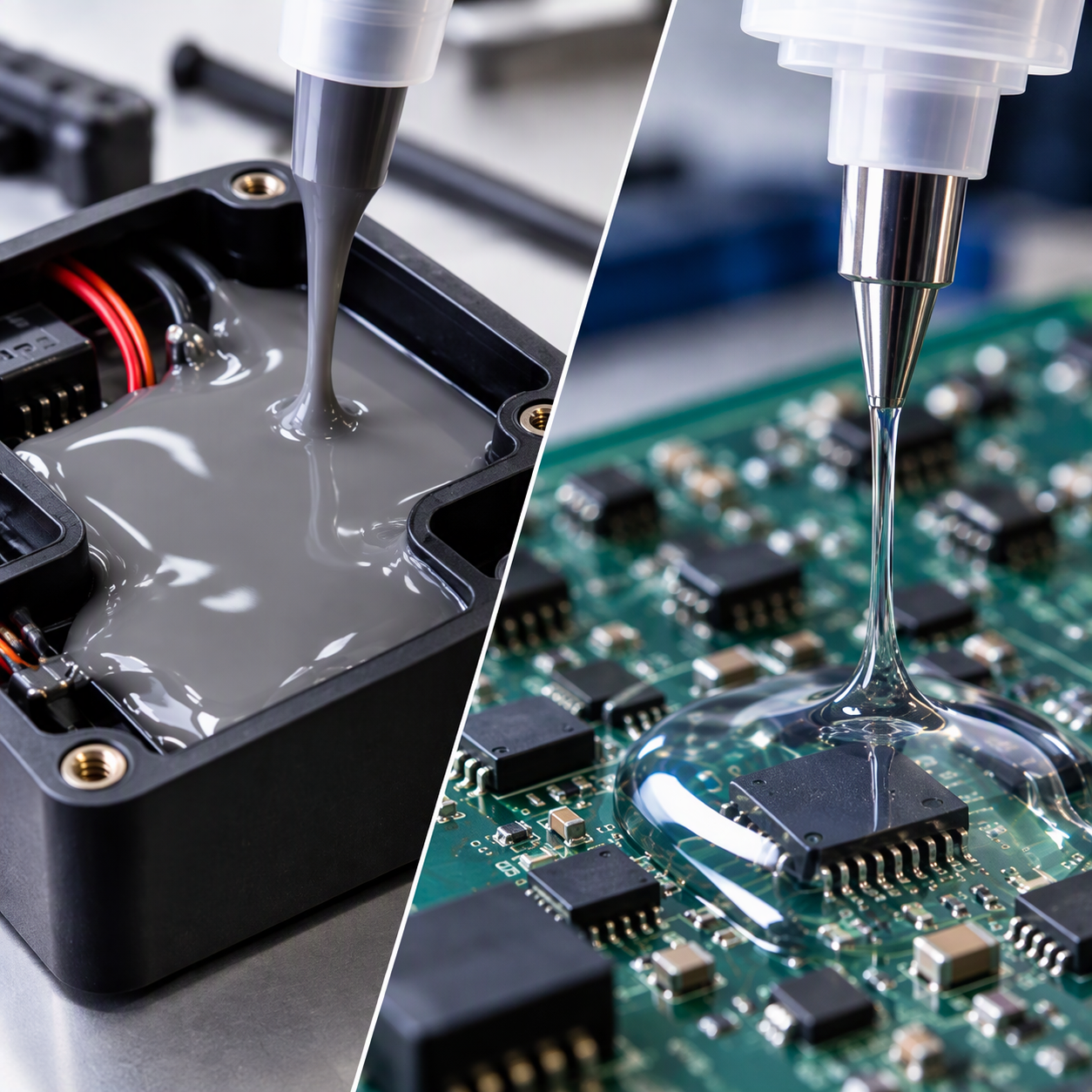
Encapsulation and potting
Encapsulation, or potting, is the process of pouring resins – epoxies, silicones, urethanes, hybrids – into cavities containing electronic components to insulate and hold them in place while providing protection from shock and vibration.
For example, sensitive components on PCBs require protection against external factors such as humidity, dust and chemicals.
LED assemblies, exposed to UV radiation or heat, require potting compounds as well.
PROTAVIC has developed a range of cyanate ester-based liquid resins which outperform the thermal resistance of current silicone and epoxy resins while ensuring very low CTE and strong adhesion to various substrates.
Some examples are listed in the following table.
Technical description
Name
Color
Chemistry
Density
Viscosity at 25°C (mPa.s)
Glass transition temperature (TG)
CTE (ppm/°C)
Shore hardness
Thermal conductivity (W/(m.K))
Use
Dielectric strength (kV/mm)
Open time
Polymerization / Crosslinking
Storage
Particle diameter
PNE 30284
Black
Epoxy
1.84
25000
160°C
21
D94
-
-
-
24 hours
3h at 160°C
6 months at 25°C
-
PNE-36567
Amber
Epoxy
-
-
-
-
-
-
-
-
-
-
-
-
PNE-37850
Clear
Epoxy
-
-
-
-
-
-
-
-
-
-
-
-
PNU-46202
Clear
2 Component Polyurethane
1:1
8000
-38
-
80
-
-
-
-
-
1 year at room temperature
-
PTS 46303-3
Dark Gray
Silicone
-
12000
-48°C
250
A35
1
-
25
4 hours
20 min at 125°C
6 months at 25°C
-
PNE 30284
Black
Epoxy
Chemistry1.84
Density25000
Viscosity at 25°C (mPa.s)160°C
Glass transition temperature (TG)21
CTE (ppm/°C)D94
Shore hardness-
Thermal conductivity (W/(m.K))-
Use-
Dielectric strength (kV/mm)24 hours
Open time3h at 160°C
Polymerization / Crosslinking6 months at 25°C
Storage-
Particle diameterPNE-36567
Amber
Epoxy
Chemistry-
Density-
Viscosity at 25°C (mPa.s)-
Glass transition temperature (TG)-
CTE (ppm/°C)-
Shore hardness-
Thermal conductivity (W/(m.K))-
Use-
Dielectric strength (kV/mm)-
Open time-
Polymerization / Crosslinking-
Storage-
Particle diameterPNE-37850
Clear
Epoxy
Chemistry-
Density-
Viscosity at 25°C (mPa.s)-
Glass transition temperature (TG)-
CTE (ppm/°C)-
Shore hardness-
Thermal conductivity (W/(m.K))-
Use-
Dielectric strength (kV/mm)-
Open time-
Polymerization / Crosslinking-
Storage-
Particle diameterPNU-46202
Clear
2 Component Polyurethane
Chemistry1:1
Density8000
Viscosity at 25°C (mPa.s)-38
Glass transition temperature (TG)-
CTE (ppm/°C)80
Shore hardness-
Thermal conductivity (W/(m.K))-
Use-
Dielectric strength (kV/mm)-
Open time-
Polymerization / Crosslinking1 year at room temperature
Storage-
Particle diameterPTS 46303-3
Dark Gray
Silicone
Chemistry-
Density12000
Viscosity at 25°C (mPa.s)-48°C
Glass transition temperature (TG)250
CTE (ppm/°C)A35
Shore hardness1
Thermal conductivity (W/(m.K))-
Use25
Dielectric strength (kV/mm)4 hours
Open time20 min at 125°C
Polymerization / Crosslinking6 months at 25°C
Storage-
Particle diameter